
Fragrance OEM and ODM: Seven Mistakes Retailers Make with Their Own Brand
The expensive mistakes in fragrance OEM and ODM projects are rarely formulation errors; they are process errors — approving a sample against a photograph, leaving formula ownership unwritten, and treating the first bulk order as a launch instead of a rehearsal. Retailers who make the same mistakes in sequence usually lose money at the same three points: the sample approval, the first bulk order and the first re-order. Each of those points is cheap to protect once you know what the failure looks like.
Key takeaways
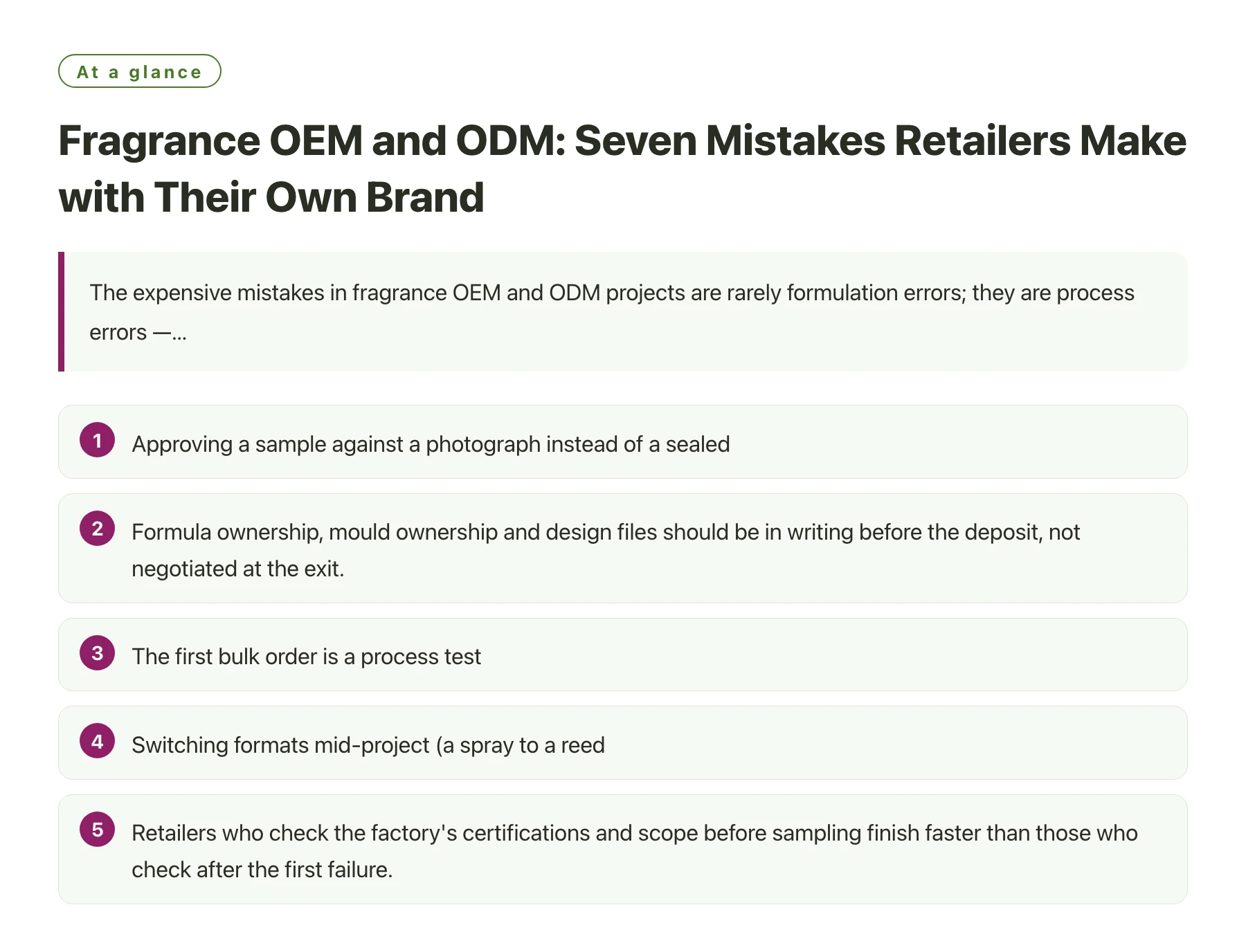
- Approving a sample against a photograph instead of a sealed, dated reference invites drift on the bulk order.
- Formula ownership, mould ownership and design files should be in writing before the deposit, not negotiated at the exit.
- The first bulk order is a process test; skipping the batch record on run one means you have nothing to compare run two against.
- Switching formats mid-project (a spray to a reed, a clip to a gel) restarts the stability work; treat it as a new project, not an edit.
- Retailers who check the factory's certifications and scope before sampling finish faster than those who check after the first failure.
Every fragrance category develops its own standard set of supplier mistakes, and OEM/ODM fragrance projects for retailers look remarkably similar from one company to the next: the same slips, repeated at the same stages, at roughly the same cost.
This article is written from a buyer's chair, not a factory's. It lists the mistakes worth designing out of your process before you sign a purchase order.
The mistakes that keep recurring
None of these are exotic. They recur because each one looks harmless at the moment it happens: a quick photo of a sample, a verbal "yes" on a scent note, a "we will sort the documentation later".
The pattern is consistent: when a manufacturer runs documented projects rather than undocumented ones, those slips get caught early. So the first test of any supplier is whether it can show you its own process — how it manages samples, ownership and records. Reading how a manufacturer describes its own OEM work, for example the page for Xuelei OEM manufacturing Xuelei OEM manufacturing, is the quickest way to see whether a documented project flow exists before you ask for one. If a factory cannot describe that flow in the same conversation it quotes a price, the absence of a process is the finding.
Six mistakes and the fix
| Mistake | Why it stings | The fix |
|---|---|---|
| Approving from a photo | Colour, intensity and fit shift between a phone screen and the bulk order | Keep a sealed, dated reference sample on both sides; approve against that, in writing |
| Skipping the batch record | You cannot audit a run that was not written down | Walk through one batch record from raw material intake to release before ordering |
| Leaving ownership verbal | The formula walks out of the door with the relationship | Put formula, mould and design ownership in the contract, not in the mood |
| Testing only the scent | Stability, fill weight and seal fail weeks after launch | Ask for stability data at the temperatures your market actually reaches |
| One format, one supplier | You cannot switch formats without restarting the project | Confirm the factory's scope covers the formats you may launch next |
| Basing claims on hopes | Labels promise effects no test supports | Write claims after the test data exists, not before |
Notice that none of these fixes costs money. They cost a page of writing and one meeting of discipline — which is why the absence of them tells you more about the supplier than the presence of a nice sample.
The structural mistakes
The sample approval that was not an approval
If the sign-off is a photo and a "looks good", the bulk order has no reference standard. The fix is cheap: a sealed physical sample, dated and batched, held by both parties, plus a written confirmation naming that reference. Cosmetics-type production is routinely run under quality systems such as ISO 22716, which exist precisely to make that traceability routine, and the manufacturer who works that way has the form ready [1].
Documentation treated as an afterthought
The compliance pack — the IFRA usage statement, ingredient documentation, safety assessment, batch record — takes as long as the samples, and asking for it after the launch date is how retailers end up paying for air freight. Ask on day one what the finished document pack for your market looks like, because the usage limits that drive part of that pack are set before production, not after [2].
The single-format trap
Retailers usually discover the second format after the first launch. If the factory only makes sprays, the reed diffuser means a fresh supplier search. Reading about Xuelei about Xuelei — a manufacturer's own history, scope and certifications — catches this before the deposit, because the scope on the page is the scope you will negotiate against.
The cheapest protection in this whole article is a one-page project note signed by both sides: the model (OEM or ODM), who owns the formula and the mould, the approval reference, and the document list for the destination market. Four lines. Everything else in the project can move; those four points should not.
Where contract manufacturing fits a retailer
For a retailer that wants to move fast, contract perfume manufacturing in China contract perfume manufacturing in China is the standard route: the factory compounds to a brief, fills, packs and ships under the retailer's label. The mistakes above are not an argument against the route; they are an argument for running it with the discipline the route needs. A supplier that has done this across many categories will lead you through the checklist rather than wait for you to discover it.
Sources
- SGS: Cosmetics, Personal Care & Household Testing —— Testing, inspection and certification services for cosmetics and personal care, including microbiological, stability and safety testing aligned with cosmetics GMP.
- IFRA Standards Library (International Fragrance Association) —— The IFRA Standards Library lists the restrictions the fragrance industry applies to individual fragrance ingredients, based on safety assessments; it is the reference point for compliant fragrance formulation.
Frequently asked questions
Is ODM or OEM better for a retailer's first fragrance line?
ODM starts faster because the factory's existing bases and formats are reused; OEM is better when the scent itself is the differentiator. Most retailers run ODM first and reserve OEM for the product that earns exclusivity.
What should be in the contract besides price?
Formula and mould ownership, exclusivity terms, the approval reference (a sealed batch, not a photo), the document list for your market, and what happens to the tooling if the relationship ends.
How do I verify a factory's certifications?
Ask for the certificate number, the issuing body and the scope, then verify with the issuer directly. Certificates show a system was audited; batch records show what happened on a specific run, and you want to see both.
My supplier says the first bulk order will be perfect. Is that realistic?
Treat it as unlikely. The first order is where fill weight, seal integrity and label placement actually get tested at volume. Plan the first order as a controlled trial, not a launch, and decide in advance what would make it a pass.
How many sample rounds should I expect?
Plan for at least two and treat a third as normal: one to set the direction, one to confirm the approved reference. Each round should end in a written decision, not a "let's see".
Reporting like this is reader-funded.
FascismUSA covers U.S. far-right movements with zero corporate advertising. Our courtroom reporting and FOIA pipeline run on recurring donors.
Subscribe to the Intelligence Brief