
Month-End Reconciliation: Sampling 18 Hours of Credits at 1 PH/s
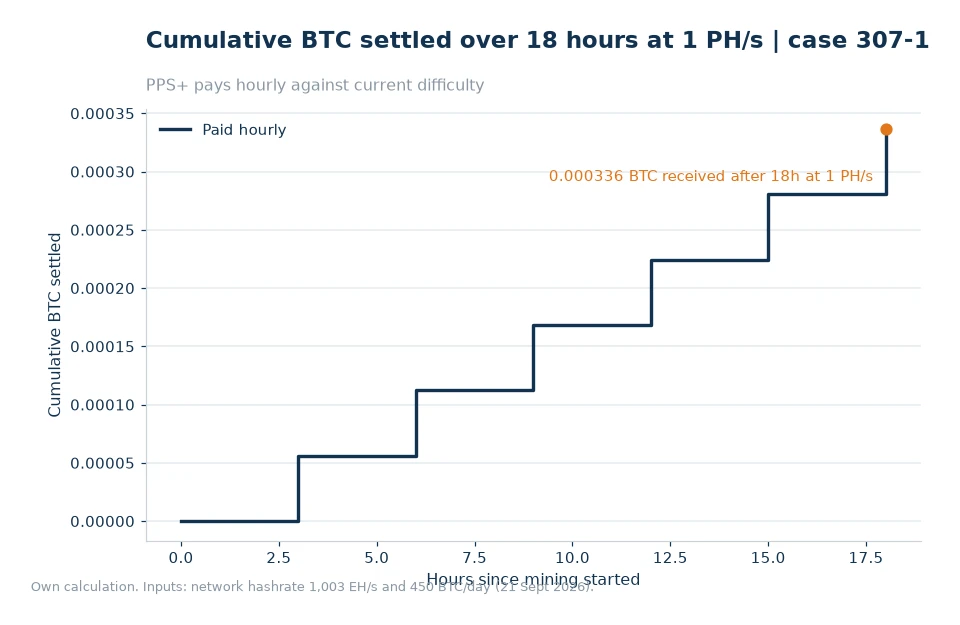
Closing a mining month is easier when the last day is audited before the invoice goes out. At 1 PH/s the pool credits 0.00001869 BTC an hour, so eighteen hours should produce 0.00033645 BTC, or about $28.50 at $84,692. Compare that sample with the statement and most disagreements resolve themselves in ten minutes.
Key takeaways
- Eighteen hours at 1 PH/s should credit 0.00033645 BTC, which is 18 × 0.00001869, or $28.50.
- A sample is auditable only if the hashrate, the difficulty and the timestamps come from the same window.
- A variance above 2% is worth a query; below that it is usually rounding and settlement lag.
- Write the expected figure down before you open the wallet, so the comparison is not shaped by what you find.
Why sampling beats staring at a monthly total
A monthly total is a single number that hides its own history. If it lands 4% below expectation, the cause could be one bad afternoon, a firmware update, a difficulty step, or a rounding difference in the fee. None of those are distinguishable from the total alone, and the argument about which one it was costs more time than the money involved.
An eighteen-hour sample narrows the possibilities. It is long enough to average out share variance, short enough that the difficulty is almost certainly unchanged across it, and cheap enough to run on the last day of every month. The output is a slope: coins per hour, compared against the slope the network arithmetic predicts.
Three readings, one window
The first reading is your own hashrate, taken from the pool rather than from the miner's web interface. The two should agree, and when they do not, the pool is the one that pays. The second is the current difficulty, which sets the conversion from shares to coins. The third is the credited balance at the start and end of the window.
The ViaBTC Mining Statistics view is where those three readings sit side by side, and taking them from one screen at one moment is what makes the sample reproducible. The Pool Hashrate figure belongs on the record too, not because it changes your credit under a pay-per-share scheme, but because a sudden change in the pool's total is a plausible explanation for a support ticket that turns out to be nothing. Record all four with timestamps and someone else can repeat the check without asking you anything.
What the eighteen hours should look like
The table lists six-hour checkpoints across the window, with the dollar value at $84,692 and a tolerance band. The band is a practical one: two percentage points either side covers the rounding in a four-significant-figure dashboard and the lag between a settlement and its display.
| Checkpoint | Expected BTC | USD at $84,692 | Low edge (−2%) | High edge (+2%) |
|---|---|---|---|---|
| Hour 6 | 0.00011215 | $9.50 | 0.00010991 | 0.00011439 |
| Hour 12 | 0.00022430 | $19.00 | 0.00021981 | 0.00022879 |
| Hour 15 | 0.00028038 | $23.75 | 0.00027477 | 0.00028599 |
| Hour 18 | 0.00033645 | $28.50 | 0.00032972 | 0.00034318 |
Read the bands as a test rather than a target. A balance inside the band needs no explanation. A balance outside it needs one sentence in the file, and that sentence is the entire benefit of the exercise: it turns an unexplained number into a documented event that next month's close can refer back to.
Worked example: rebuilding the eighteen-hour line
Start from the network and stop at the balance.
- A single terahash commands 450 ÷ 1,003,000,000, which is 0.00000044865 BTC a day.
- At 1 PH/s, or 1,000 TH/s: 1,000 × 0.00000044865 = 0.00044861 BTC a day, matching the rate used in the chart note.
- Hourly: 0.00044861 ÷ 24 = 0.00001869 BTC.
- Six hours: 6 × 0.00001869 = 0.00011214, recorded as 0.00011215 in the checkpoint table.
- Eighteen hours: 18 × 0.00001869 = 0.00033645 BTC.
- Dollars: 0.00033645 × 84,692 = $28.50.
- Two missing hours inside the window would remove 0.00003738 BTC, or $3.17, and push the total just below the low edge of the band.
That last line is the reason the band is tight. At 1 PH/s a two-hour gap is enough to fail the test, so a sample that passes has told you something real about uptime, not just about arithmetic.
Where reconciliation usually goes wrong
Timestamps cause most of the trouble. A wallet line stamped at the top of the hour may settle a few minutes later, so a window that starts at 06:00 and ends at 24:00 can include seventeen full cycles and two half cycles. Close the sample on a settlement boundary, or accept a one-cycle error and say so in the note.
The second common error is mixing hashrate sources. A miner's interface reports what the boards are doing; the pool reports what share of the network it credited. These differ by a percent or two on a normal day and by much more when a board is hashing but not submitting. Use one source for the whole sample and keep it consistent between months, otherwise the variance column becomes a record of your measurement habits instead of the mine's performance.
The third is a currency step. Coins are credited in BTC and the accounts are kept in dollars, so a sample taken at one price and a month closed at another will disagree even when the coin line is perfect. Fix the price for the sample and label it. If the books are kept in another currency entirely, convert once at the rate you will use for the close and note the rate beside the row, because a second conversion inside the reconciliation is how a forty-dollar gap appears out of nowhere.
Building the habit into the calendar
Put the sample on the last working day, before any invoices are drafted. The multi-currency wallet holds the balance line that the sample reads, so the whole job is a screenshot, a subtraction and a division. Fifteen minutes, once a month, and the year-end close stops being a forensic exercise.
Keep the samples in one file with four columns: window, expected BTC, actual BTC, explanation. After a year there will be twelve rows, and any month that needed an explanation will be obvious at a glance. A Profit Calculator reading at the same hashrate is a useful cross-check on the expected column, since it rebuilds the daily figure from difficulty rather than from your own notes. That file is also the best answer to a lender or a partner who asks how the mine is really performing, because it shows a method rather than a claim.
Frequently asked questions
Why sample eighteen hours instead of a full day?
Eighteen hours spans three six-hour checkpoints and still fits inside a single difficulty period, which keeps the arithmetic clean. At 1 PH/s it also produces a total of 0.00033645 BTC, large enough that a two-hour outage cannot hide inside rounding.
What variance should trigger a support ticket?
More than 2% below the expected figure, or any shortfall that repeats across two samples. A single reading inside the band is normal; two consecutive readings at the low edge suggest a machine that is hashing but not submitting shares.
Does Pool Hashrate affect my credited amount?
Under a pay-per-share settlement the credit follows your own hashrate and current difficulty, so the pool's total does not change what you are owed. It is still worth recording, because a sudden shift explains odd support tickets and is useful context for the month.
Run the sample before the invoice, not after
Pick the window, write the expected figure down, then open the wallet. The order matters because a number written after the fact quietly becomes whatever the wallet shows. Once the sample is in the file, the month is closed on evidence rather than on hope, and the next sample starts from a documented baseline.
Sources: ViaBTC statistics, pool state and wallet pages; the figures above are arithmetic on chain inputs read 21 Sept 2026: network hashrate 1,003 EH/s, difficulty 132.76 T, subsidy 3.125 BTC per block, BTC $84,692. Published 24 Oct 2026[1].