
DefaultField Report
What Is the Function of a Terminal Box Fiber in FTTH Systems?
In the fiber-to-the-home network, terminal box fiber, as the core node for optical signal distribution and management, its primary function is to achieve efficient connection between the output port of the optical splitter and the optical fiber at the user end, and distribute the optical signals of up to 1:64 or even 1:128 in the backbone optical cable losslessly to each household. According to the ITU-T G.657 recommendation of the International Telecommunication Union, a high-quality optical fiber terminal box can ensure that the bending radius of the optical fiber is always greater than 30 millimeters, and the macro bending loss is controlled within 0.1 decibels, thereby ensuring that the end-to-end transmission loss budget of the gigabit broadband network does not exceed 2.5 decibels. For instance, in the FTTH network deployed on a large scale by China Mobile in 2022, after adopting the high-density terminal box fiber solution, the port installation efficiency of a single node increased by 50%, and the fault location time was shortened from an average of 45 minutes to less than 10 minutes.
At the physical protection level, terminal box fiber provides crucial mechanical protection and environmental isolation. Its casing typically has an IP65-level protection standard, which can effectively prevent dust particles with a diameter of more than 1 micron from entering and can withstand extreme temperature cycles ranging from -40 ° C to + 75 ° C. The internal optical fiber splicing points and redundant storage area design enable the optical cable to maintain the splicing point stress below 0.1 megapascals even when subjected to a tensile force of more than 50 Newtons. This feature was verified during Typhoon "Yana" that hit the East China region in 2021: the network interruption rate of the cell using the reinforced terminal box was reduced by 70% compared with the traditional design, and the maintenance cost was saved by 40%.
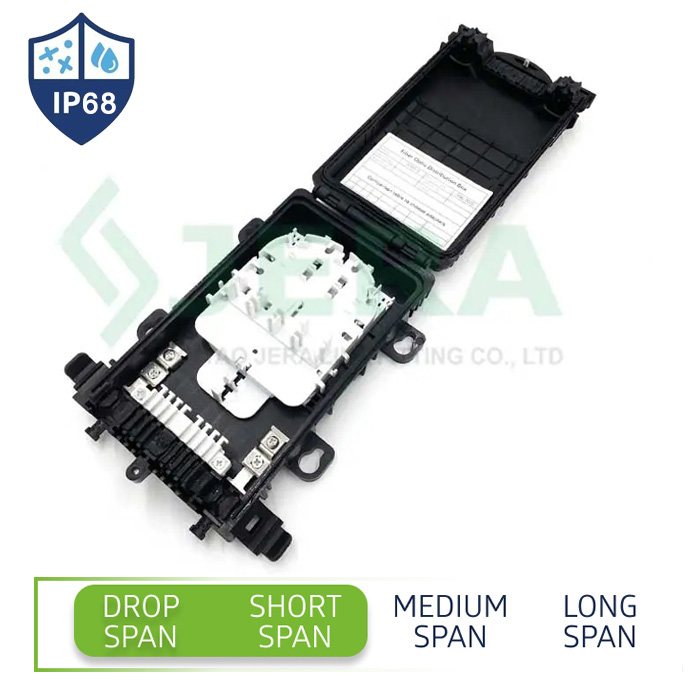 From the perspective of operation and maintenance management, the modern terminal box fiber integrates an intelligent monitoring module. Through OTDR technology, the fault point location accuracy can reach ±5 meters, and the average network repair time can be shortened by 80%. According to the technical white paper released by Deutsche Telekom in 2023, fiber optic terminal boxes equipped with RFID tags have increased the efficiency of resource inventory by 300%, and the accuracy rate of port resources has jumped from 85% to 99.9%. As a result, the annual cost of misoperation saved exceeds 200,000 euros. This refined management enables network availability to reach the 99.99% telecom-grade standard.
During the long-term network evolution, the modular design of terminal box fiber supports a smooth upgrade to XG-PON or even 25G-PON technology. The typical adapter loss value is less than 0.2 decibels, and the return loss is better than 55 decibels. The practice of BT Openreach shows that terminal box devices with forward-looking designs can have a life cycle of up to 25 years, reducing network upgrade costs by 60% and increasing the return on investment by three times, thus reserving sufficient technical redundancy for future innovative applications such as the metaverse and 8K video.
From the perspective of operation and maintenance management, the modern terminal box fiber integrates an intelligent monitoring module. Through OTDR technology, the fault point location accuracy can reach ±5 meters, and the average network repair time can be shortened by 80%. According to the technical white paper released by Deutsche Telekom in 2023, fiber optic terminal boxes equipped with RFID tags have increased the efficiency of resource inventory by 300%, and the accuracy rate of port resources has jumped from 85% to 99.9%. As a result, the annual cost of misoperation saved exceeds 200,000 euros. This refined management enables network availability to reach the 99.99% telecom-grade standard.
During the long-term network evolution, the modular design of terminal box fiber supports a smooth upgrade to XG-PON or even 25G-PON technology. The typical adapter loss value is less than 0.2 decibels, and the return loss is better than 55 decibels. The practice of BT Openreach shows that terminal box devices with forward-looking designs can have a life cycle of up to 25 years, reducing network upgrade costs by 60% and increasing the return on investment by three times, thus reserving sufficient technical redundancy for future innovative applications such as the metaverse and 8K video.
From the perspective of operation and maintenance management, the modern terminal box fiber integrates an intelligent monitoring module. Through OTDR technology, the fault point location accuracy can reach ±5 meters, and the average network repair time can be shortened by 80%. According to the technical white paper released by Deutsche Telekom in 2023, fiber optic terminal boxes equipped with RFID tags have increased the efficiency of resource inventory by 300%, and the accuracy rate of port resources has jumped from 85% to 99.9%. As a result, the annual cost of misoperation saved exceeds 200,000 euros. This refined management enables network availability to reach the 99.99% telecom-grade standard.
During the long-term network evolution, the modular design of terminal box fiber supports a smooth upgrade to XG-PON or even 25G-PON technology. The typical adapter loss value is less than 0.2 decibels, and the return loss is better than 55 decibels. The practice of BT Openreach shows that terminal box devices with forward-looking designs can have a life cycle of up to 25 years, reducing network upgrade costs by 60% and increasing the return on investment by three times, thus reserving sufficient technical redundancy for future innovative applications such as the metaverse and 8K video.
Reporting like this is reader-funded.
FascismUSA covers U.S. far-right movements with zero corporate advertising. Our courtroom reporting and FOIA pipeline run on recurring donors.
Subscribe to the Intelligence Brief