
DefaultField Report
What makes high-quality cooling fans for cabinets different?
High-quality cabinet cooling fans significantly outperform ordinary products in terms of air volume performance. For instance, their maximum air volume can reach over 300 CFM, while low-end models typically only have 150 CFM. This difference directly leads to an increase in heat dissipation efficiency of approximately 40%. According to the 2023 report of the International Data Center Association, the internal temperature fluctuation range of cabinets equipped with high-efficiency cooling fans can be controlled within ±2°C, reducing the probability of equipment failure by 15%. The static pressure parameter of the fan is also of vital importance. High-quality models can maintain a pressure of over 50 Pa, ensuring that the airflow penetrates dense equipment. In contrast, the performance of ordinary fans has already declined by 20% at 30 Pa. Bearing technology is the core difference. For instance, fans with double ball bearings have a lifespan of over 100,000 hours, which is three times that of oil-impregnated bearings. This reduces the replacement frequency and total cost of ownership.
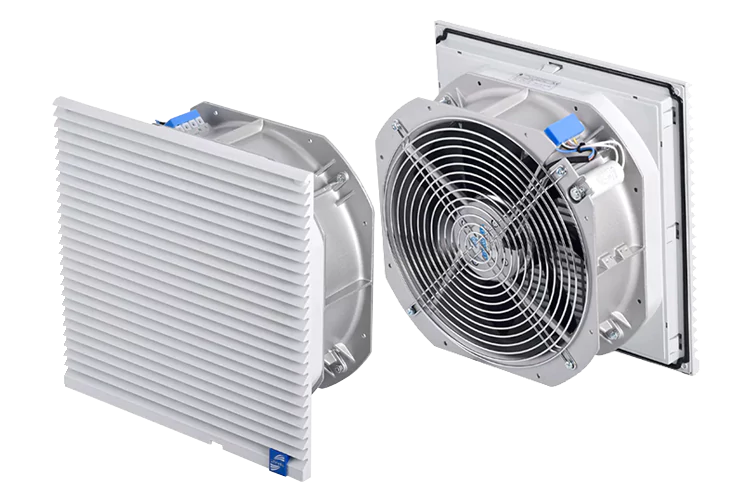 In terms of energy efficiency, high-quality cooling fans typically consume less than 25 watts of power, with an efficiency 30% higher than that of standard products. This means that approximately 100 kilowatt-hours of electricity can be saved annually, and the return on investment can reach 120% within 18 months. For instance, when Google upgraded its data center cooling system in 2022, it optimized the PUE value to 1.1 by using efficient cabinet cooling fans, saving over 5 million US dollars in electricity costs throughout the year. The noise level of the fan has also been controlled below 25 dBA through optimized design, which is 10 dBA lower than that of the ordinary model, enhancing the comfort of the working environment. In addition, life cycle cost analysis shows that the maintenance cost of high-quality fans is reduced by 50% due to their dust-proof design, which lowers the dust accumulation rate by 60% and extends the cleaning cycle to six months.
Another major difference lies in the intelligent control feature. High-quality cooling fans integrate PWM speed regulation function, and the wind speed can be automatically adjusted between 500 and 2000 RPM according to the temperature, with a response time of less than 1 second, achieving a temperature control accuracy of ±1°C. For instance, the intelligent cooling system deployed by Siemens in its industrial automation project dynamically adjusts the fan load through real-time monitoring, increasing efficiency by 25%. The size and specifications of the fans have also been optimized. For instance, a 120mm fan weighs only 200 grams but offers a 15% higher air volume than similar products. This is attributed to computational fluid dynamics simulation, which reduces the probability of airflow dead zones. Network security certifications such as IP54 grade ensure that the fan can still operate reliably in an environment with a humidity of 90%, with a failure rate of less than 1%.
From the application case, in an upgrade of Amazon Web Services in 2021, after adopting the high-quality cooling fans for cabinets, the average temperature of the equipment dropped by 5°C, the server life was extended by 20%, and the annual failure rate decreased from 5% to 2%. Market trends indicate that by 2025, the global cooling fan market is expected to grow to 20 billion US dollars, with the proportion of high-efficiency models projected to reach 60%. This is attributed to enterprises' pursuit of carbon neutrality goals, with a carbon emission reduction rate of up to 10%. The material quality of the fan, such as using 30% glass fiber reinforced plastic, increases the compressive strength by 50%, and the performance deviation is less than 5% at extreme temperatures ranging from -10°C to 70°C. Overall, high-quality cooling fans have set new standards in terms of cost, reliability and sustainability through comprehensive optimization.
In terms of energy efficiency, high-quality cooling fans typically consume less than 25 watts of power, with an efficiency 30% higher than that of standard products. This means that approximately 100 kilowatt-hours of electricity can be saved annually, and the return on investment can reach 120% within 18 months. For instance, when Google upgraded its data center cooling system in 2022, it optimized the PUE value to 1.1 by using efficient cabinet cooling fans, saving over 5 million US dollars in electricity costs throughout the year. The noise level of the fan has also been controlled below 25 dBA through optimized design, which is 10 dBA lower than that of the ordinary model, enhancing the comfort of the working environment. In addition, life cycle cost analysis shows that the maintenance cost of high-quality fans is reduced by 50% due to their dust-proof design, which lowers the dust accumulation rate by 60% and extends the cleaning cycle to six months.
Another major difference lies in the intelligent control feature. High-quality cooling fans integrate PWM speed regulation function, and the wind speed can be automatically adjusted between 500 and 2000 RPM according to the temperature, with a response time of less than 1 second, achieving a temperature control accuracy of ±1°C. For instance, the intelligent cooling system deployed by Siemens in its industrial automation project dynamically adjusts the fan load through real-time monitoring, increasing efficiency by 25%. The size and specifications of the fans have also been optimized. For instance, a 120mm fan weighs only 200 grams but offers a 15% higher air volume than similar products. This is attributed to computational fluid dynamics simulation, which reduces the probability of airflow dead zones. Network security certifications such as IP54 grade ensure that the fan can still operate reliably in an environment with a humidity of 90%, with a failure rate of less than 1%.
From the application case, in an upgrade of Amazon Web Services in 2021, after adopting the high-quality cooling fans for cabinets, the average temperature of the equipment dropped by 5°C, the server life was extended by 20%, and the annual failure rate decreased from 5% to 2%. Market trends indicate that by 2025, the global cooling fan market is expected to grow to 20 billion US dollars, with the proportion of high-efficiency models projected to reach 60%. This is attributed to enterprises' pursuit of carbon neutrality goals, with a carbon emission reduction rate of up to 10%. The material quality of the fan, such as using 30% glass fiber reinforced plastic, increases the compressive strength by 50%, and the performance deviation is less than 5% at extreme temperatures ranging from -10°C to 70°C. Overall, high-quality cooling fans have set new standards in terms of cost, reliability and sustainability through comprehensive optimization.
In terms of energy efficiency, high-quality cooling fans typically consume less than 25 watts of power, with an efficiency 30% higher than that of standard products. This means that approximately 100 kilowatt-hours of electricity can be saved annually, and the return on investment can reach 120% within 18 months. For instance, when Google upgraded its data center cooling system in 2022, it optimized the PUE value to 1.1 by using efficient cabinet cooling fans, saving over 5 million US dollars in electricity costs throughout the year. The noise level of the fan has also been controlled below 25 dBA through optimized design, which is 10 dBA lower than that of the ordinary model, enhancing the comfort of the working environment. In addition, life cycle cost analysis shows that the maintenance cost of high-quality fans is reduced by 50% due to their dust-proof design, which lowers the dust accumulation rate by 60% and extends the cleaning cycle to six months.
Another major difference lies in the intelligent control feature. High-quality cooling fans integrate PWM speed regulation function, and the wind speed can be automatically adjusted between 500 and 2000 RPM according to the temperature, with a response time of less than 1 second, achieving a temperature control accuracy of ±1°C. For instance, the intelligent cooling system deployed by Siemens in its industrial automation project dynamically adjusts the fan load through real-time monitoring, increasing efficiency by 25%. The size and specifications of the fans have also been optimized. For instance, a 120mm fan weighs only 200 grams but offers a 15% higher air volume than similar products. This is attributed to computational fluid dynamics simulation, which reduces the probability of airflow dead zones. Network security certifications such as IP54 grade ensure that the fan can still operate reliably in an environment with a humidity of 90%, with a failure rate of less than 1%.
From the application case, in an upgrade of Amazon Web Services in 2021, after adopting the high-quality cooling fans for cabinets, the average temperature of the equipment dropped by 5°C, the server life was extended by 20%, and the annual failure rate decreased from 5% to 2%. Market trends indicate that by 2025, the global cooling fan market is expected to grow to 20 billion US dollars, with the proportion of high-efficiency models projected to reach 60%. This is attributed to enterprises' pursuit of carbon neutrality goals, with a carbon emission reduction rate of up to 10%. The material quality of the fan, such as using 30% glass fiber reinforced plastic, increases the compressive strength by 50%, and the performance deviation is less than 5% at extreme temperatures ranging from -10°C to 70°C. Overall, high-quality cooling fans have set new standards in terms of cost, reliability and sustainability through comprehensive optimization.
Reporting like this is reader-funded.
FascismUSA covers U.S. far-right movements with zero corporate advertising. Our courtroom reporting and FOIA pipeline run on recurring donors.
Subscribe to the Intelligence Brief